


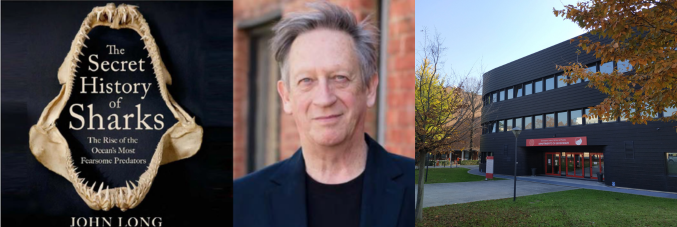
Seminar - The Secret History of Sharks. A story of evolution and survival
Speaker: Prof. John Long - College of Science and Engineering, Flinders University, Adelaide (South Australia) | Thursday 19 February 2026 | 3,30 p.m. - Classroom 1F
19.02.2026
Chondrichthyans (sharks, rays and holocephalans) originated around 465 million years ago, but their fossil record is very scant for the first few tens of millions of years. They survived all 5 of Earth's mass extinction events, but they haven't always had it easy. Their origin story (Ordovician-Devonian periods) involves the evolution of a suite of shark special abilities and a long rivalry with the armored fishes (placoderms), followed by a rising competition from the rapidly diversifying bony fishes. Carboniferous sharks became the dominant fishes in our oceans for a brief time. Buzz-saw sharks like Helicoprion at around 10m long were the largest sharks of the Paleozoic Era. Sharks were mostly small after the end Permian-extinction, and competition from huge marine reptiles during the Mesozoic Era drove new evolutionary radiations. Modern sharks began appearing as early neoselachians in the late Triassic, with several extant families of sharks becoming established from the mid Jurassic onwards, including the rays. Surviving the asteroid that wiped out dinosaurs, sharks then had to compete against the rise of whales, with the ensuing arms race gave us the appearance of our greatest predator, the 18-24m long Otodus megalodon. Today many sharks are under threat from overfishing, the denigration of oceanic environments and climate change. We can still learn a lot from researching sharks, from stunning new medical advances to help humans, through to how significant sharks are at keeping our oceans healthy.
The speaker. Prof. John Long is Emeritus Professor in Palaeontology at Flinders University (South Australia). He held previous positions as Curator at The Western Australian Museum (1989-2004), Head of Sciences at Museum Victoria (2004-2009) and as a Vice President at the LA County Museum of Natural History (2009-2012). His research focuses on the early evolution of fishes. Working the Gogo fossil sites (Kimberley) for 40 years, he found many fossils of significance, including the evidence for the origins of sex in vertebrates, breathing and limb structures in stem tetrapods, and the world's oldest reptile tracks from Australia. He has published over 200 scientific papers, 160 popular science articles, and some 30 books (including children's books). He has discovered and named more than 90 new fossil species (including fishes, a dinosaur and a plesiosaur). He was elected President of the Society of Vertebrate Paleontology 2014-2016, and has won the research medals of The Royal Society of Victoria and The Royal Society of South Australia, and the 2019 Bettison and James Award for lifetime achievement.