


Seminar - Against the flow: how much can we control river sediment dynamics?
Speaker: Dr. Mirko Musa, Ecole Polytechnique Fédérale de Lausanne (EPFL), Switzerland | Tuesday 17 March 2026 | 4,30 p.m. - Arduino Classroom
17.03.2026
Sediment transport and river morphodynamics are among the most complex and least understood challenges in civil engineering and Earth sciences. While the ambition to control them may seem like wishful thinking, it has long driven scientific and engineering progress, from erosion mitigation and flood control to navigation. In its most extreme forms, this effort has produced widespread river straightening and suppression of natural dynamics—interventions now recognized as costly and often unsustainable. Yet, in the face of climate change, managing sediment dynamics remains both a necessity and a scientific challenge.
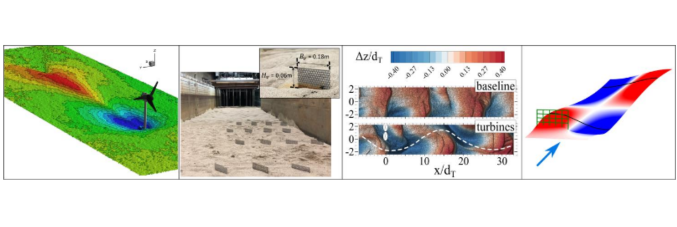
In this talk, I will present a series of non-conventional approaches to sediment control, spanning local to non-local, large scale processes and shaping my broader research vision for sustainable river engineering. At the local scale, experiments with in-stream hydrokinetic turbines and porous structures show how flow–sediment interactions can be deliberately altered to generate controlled scour, deposition, and lateral sediment transport.
Beyond localized effects, these experimental systems also reveal the emergence of large-scale morphodynamic instabilities, manifested as bar-like bed deformations.
These observations challenge traditional assumptions by suggesting that the nature and asymmetry of external forcing can actively shape river morphology. This insight has inspired a new analytical framework that integrates forcing into morphodynamic theory as asymmetric drag force and successfully reproduces key experimental patterns.
Together, these results point to the possibility that river instabilities may be influenced - and potentially guided - through controlled forcing. This perspective underpins a broader vision: developing physically grounded strategies that work with, rather than against, natural river dynamics to support sustainable river engineering.