
Understanding Earthquakes: Scientific Progress and Interdisciplinary Collaboration
Over the past few decades, scientific research on earthquakes has made significant progress in understanding the mechanisms that govern the dynamics of the Earth’s crust. Today, we have increasingly precise maps of seismically active regions and geophysical models capable of describing, with remarkable accuracy, the areas where seismic events are most likely to occur and with what intensity. Tools such as satellite geodesy, high-resolution seismology, and the analysis of tectonic movements on a global scale have made it possible to clearly identify major active faults and to estimate the seismic potential of entire regions.
However, despite these important achievements, the ability to predict exactly when and where an earthquake will strike remains one of the greatest challenges in contemporary science. Despite numerous attempts, no method has proven capable of providing reliable short-term predictions, and a large part of the scientific community now believes that a deterministic prediction of earthquakes — that is, the ability to indicate the date, location, and magnitude of an event — will never be possible. Researchers therefore focus on probabilistic approaches and seismic risk assessment, which are essential tools for prevention and territorial planning.
The impact of earthquakes on the world population remains dramatic. The annual number of global casualties can vary greatly depending on whether particularly catastrophic events occur, such as the earthquakes that struck Syria and Turkey in 2023, causing over 60,000 deaths. On average, earthquakes result in 10,000 to 15,000 deaths per year and remain the most feared of geological hazards, not to mention the enormous economic damages they can cause.
These figures underscore how urgent and central it is to continue investing in scientific research, the development of increasingly sophisticated monitoring technologies, and risk mitigation strategies, in order to minimize the consequences of a natural phenomenon that, for now, remains largely unpredictable.
When Collaboration Makes the Difference
In this context, collaboration across different disciplines plays a crucial role. Understanding earthquakes requires bringing together seemingly distant areas of expertise: structural geologists, who study faults directly in the field, and seismologists, who analyze signals recorded by instruments to reconstruct the movement dynamics at depth and study the propagation of seismic waves. The exchange between these perspectives allows researchers to link surface observations with processes occurring kilometers below, providing a more complete picture of the mechanisms that trigger seismic events.
This synergy also includes the crucial role of laboratory research, where scientists can reproduce, on a smaller scale, the conditions that develop along a fault during an earthquake. In controlled environments, parameters such as temperature, pressure, and slip rate can be varied, observing the response of different rock types and collecting valuable data for modeling fracture and slip processes.
A Longstanding Collaboration
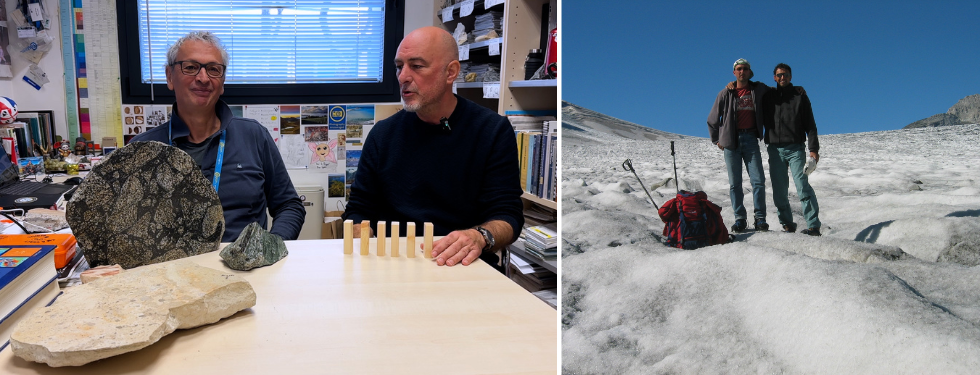
A remarkable example of this interdisciplinary collaboration is the joint work of Giulio Di Toro, structural geologist at the Department of Geosciences, University of Padova, and Stefan Nielsen, physicist and seismologist at Durham University.
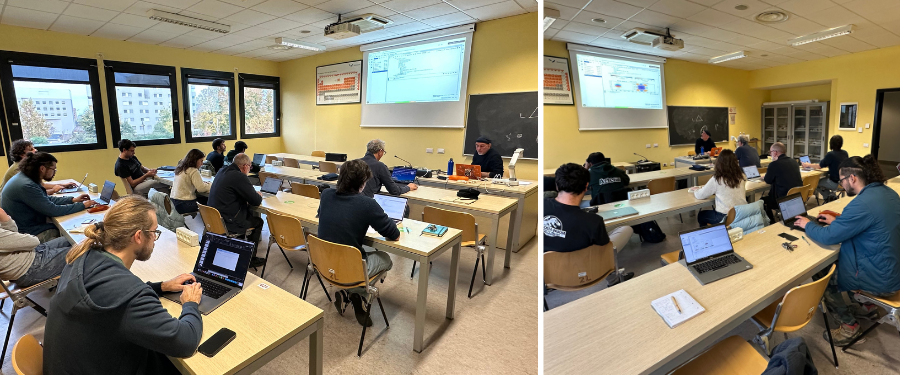
During a recent period as a visiting scientist at the Department of Geosciences, Nielsen delivered a series of seminars on the physics of earthquakes, an opportunity that further strengthened his long-standing collaboration with Giulio Di Toro.
For over twenty years, the two scientists have combined their expertise in earthquake research, publishing numerous scientific papers together, some in prestigious journals such as Nature and Science, and sharing fieldwork experiences in various seismically active regions around the world.
Despite their different academic backgrounds, Di Toro and Nielsen have found in their continuous dialogue and the complementarity of their approaches a constant source of professional inspiration and satisfaction, demonstrating how interdisciplinary cooperation is essential for advancing our understanding of one of the most complex natural phenomena on the planet.
Watch the video in which Giulio Di Toro and Stefan Nielsen discuss earthquakes and share their collaborative research experience, which began in 2004 with their first joint fieldwork on the Adamello Glacier and has continued over the years through both field activities and laboratory experiments.
Article & Video by Barbara Paknazar