


Artemis II and the Historic Return to the Moon

The moment humanity has awaited for more than half a century has finally arrived. At 12:35 a.m. Italian time on April 2, Artemis II lifted off—the first crewed mission to travel beyond Earth orbit and around the Moon since the Apollo program ended.
Aboard the Orion capsule, launched atop the Space Launch System rocket, are four astronauts: NASA’s Reid Wiseman, Victor Glover, and Christina Koch, and Jeremy Hansen from the Canadian Space Agency. The crew represents several historic firsts: Koch and Glover are the first woman and the first Black astronaut, respectively, to fly to the Moon, while Hansen is the first Canadian.
Their journey will last just under ten days, but that will be enough time to match—and in some cases surpass—the speed and distance records set during the Apollo missions. While flying over the Moon’s far side, Orion will reach the farthest point from Earth ever attained by a human-rated spacecraft. The crew is expected to exceed Apollo 13’s maximum distance of 400,171 kilometers, even as they experience temporary radio silence caused by the Moon’s interference.
A particularly challenging part of the mission will be re-entry, with Orion returning at speeds exceeding 40,000 km/h before splashing down in the Pacific Ocean off the coast of San Diego.
The mission’s primary objective is to validate life support systems and manual maneuvering capabilities in deep space—critical elements for the next stages of human exploration.
NASA has high hopes for Artemis II, marking a new era in the space race, this time competing with China. A key difference from the space programs of the past is Europe’s operational involvement. The European Space Agency provided the Orion service module, supplying energy, drinking water, and oxygen, with components manufactured in Italy. Italian contributions go further: just hours before launch, a delegation from the Italian Space Agency (ASI) and the Ministry of Enterprises and Made in Italy signed an agreement with NASA to jointly develop future lunar habitat modules.
“Fifty-two years after Apollo 17, humans are returning to orbit the Moon. Unlike the space race of the 1960s, driven by a bipolar competition between the U.S. and the USSR, Artemis is a global program involving more than 40 nations, while China advances its own lunar ambitions, making the Moon the new chessboard of the 21st century. Artemis II is only the second mission of a program that aims to establish a permanent human presence on the Moon and use it as a launch base for Mars exploration. Private companies and industries are heavily involved, expected to support annual lunar missions by the 2030s. China has announced a similar roadmap,” notes Matteo Massironi, Professor at the Department of Geosciences at the University of Padua, President of the Italian Planetary Science Society, and ESA PANGAEA scientific coordinator.
The U.S. program plans to land on the lunar surface with Artemis IV in 2028, but in the meantime, it is laying the groundwork for a long-term human presence on the Moon. This includes building infrastructure capable of supporting life in an environment with high radiation levels and frequent meteorite storms.
“The most promising locations for future permanent bases are near the lunar south pole, where permanently shadowed regions contain water ice—a critical resource for life support and fuel—while areas with near-constant sunlight would provide the necessary energy supply. Future lunar missions won’t focus solely on technological tests or scientific exploration; they must identify viable sites and local resources”, explains Massironi.
In this context, geological analysis is crucial. It ensures safe landings, effective planning of exploration traverses, selection of sites for permanent bases, and identification of usable in-situ resources—including volatiles like water, which, combined with appropriate additives and 3D printing, can help build human settlements and extract rare materials.
“For these reasons, astronauts today are specifically trained in planetary and field geology. Their unique perspective on-site allows them to act as the eyes and hands of Earth-based scientific teams”, says Massironi.
One notable program is ESA’s PANGAEA course, which for ten years has trained European, Japanese, and American astronauts in field observation and sample collection. It is a prerequisite for Artemis missions.
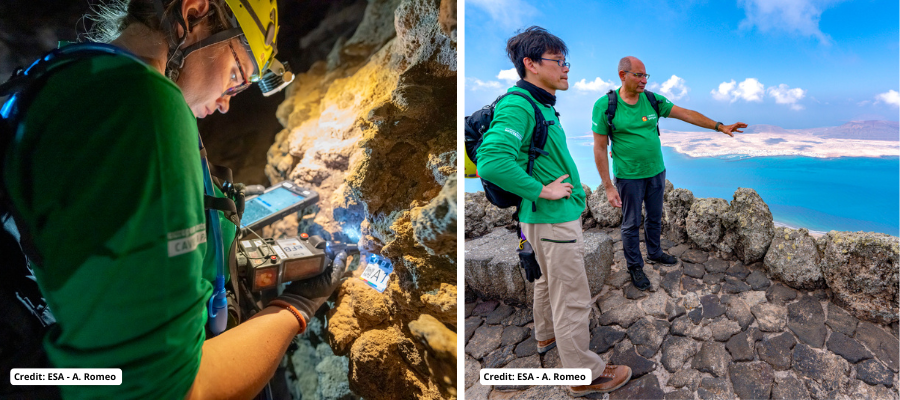
PANGAEA instructors include university faculty from across Europe, notably the University of Padua. Professors Matteo Massironi and Francesco Sauro, together with researcher Riccardo Pozzobon, helped found the course, with Massironi currently coordinating it.
As we await European astronauts’ lunar journeys, we can look forward to the geological observations of Reid Wiseman, Victor Glover, Christina Koch, and Jeremy Hansen during the next ten days aboard Orion.