


Listening to the ocean: how dolphins locate sounds without external ears

Today, more and more of our industrial activities—shipping, hydrocarbon exploitation, the construction of wind farms—take place in the oceans, leading to ever-increasing levels of underwater noise pollution.
There is growing evidence that this noise affects many marine organisms in different ways. This is especially true for cetaceans, which rely heavily on sound for many essential tasks: for instance, dolphins use sonar as a key tool for navigation and feeding.
One important aspect of SWIM—a research project funded by the PRIN-PNRR program and coordinated by Lapo Boschi at the Department of Geosciences of the University of Padua—is the study of how sound waves travel through a dolphin’s head, from the tip of the beak to the inner ears. The goal is to understand exactly how dolphins are able to locate sounds in space. This is a crucial step toward understanding how noise pollution may interfere with these abilities and, ultimately, toward helping policymakers and conservationists develop sustainable strategies to reduce marine noise pollution.
Within this context, two recent studies published in JASA (The Journal of the Acoustical Society of America) have shed light on key aspects of the dolphin auditory system.
The research team focused on a particularly intriguing aspect: how dolphins can tell whether a sound comes from above or below, or from in front of or behind them. In terrestrial mammals, this ability is achieved thanks to the external ears (pinnae), which shape incoming sounds by creating very sharp dips (known as “spectral notches”) in their frequency spectrum. These notches depend strongly on the direction from which the sound arrives—especially its elevation—making it relatively easy for the brain to determine where the sound is coming from based on the frequency at which the notch occurs.
Toothed whales do not have external ears (pinnae), and yet their so-called minimum audible angle (MAA)—the smallest angular separation between two sound sources that they can distinguish—appears to be extremely small in all directions. In bottlenose dolphins, the MAA has been observed to be as low as about 1° both horizontally and vertically. By comparison, humans achieve a similar resolution of about 1° in the horizontal plane, but perform much worse—by several degrees—when it comes to vertical localization.
This remarkable ability has led scientists to speculate that dolphins must rely on a sound localization mechanism that is profoundly different from that of other species. It is still unclear whether any specific anatomical feature has evolved to functionally replace the role of the pinnae, or whether dolphins instead rely on more sophisticated neural processing, allowing their brain to interpret more complex acoustic cues than the simple spectral dips used by terrestrial mammals. What is known, however, is that the region of the brain devoted to sound processing is much larger in toothed whales than in any terrestrial mammal, including humans.
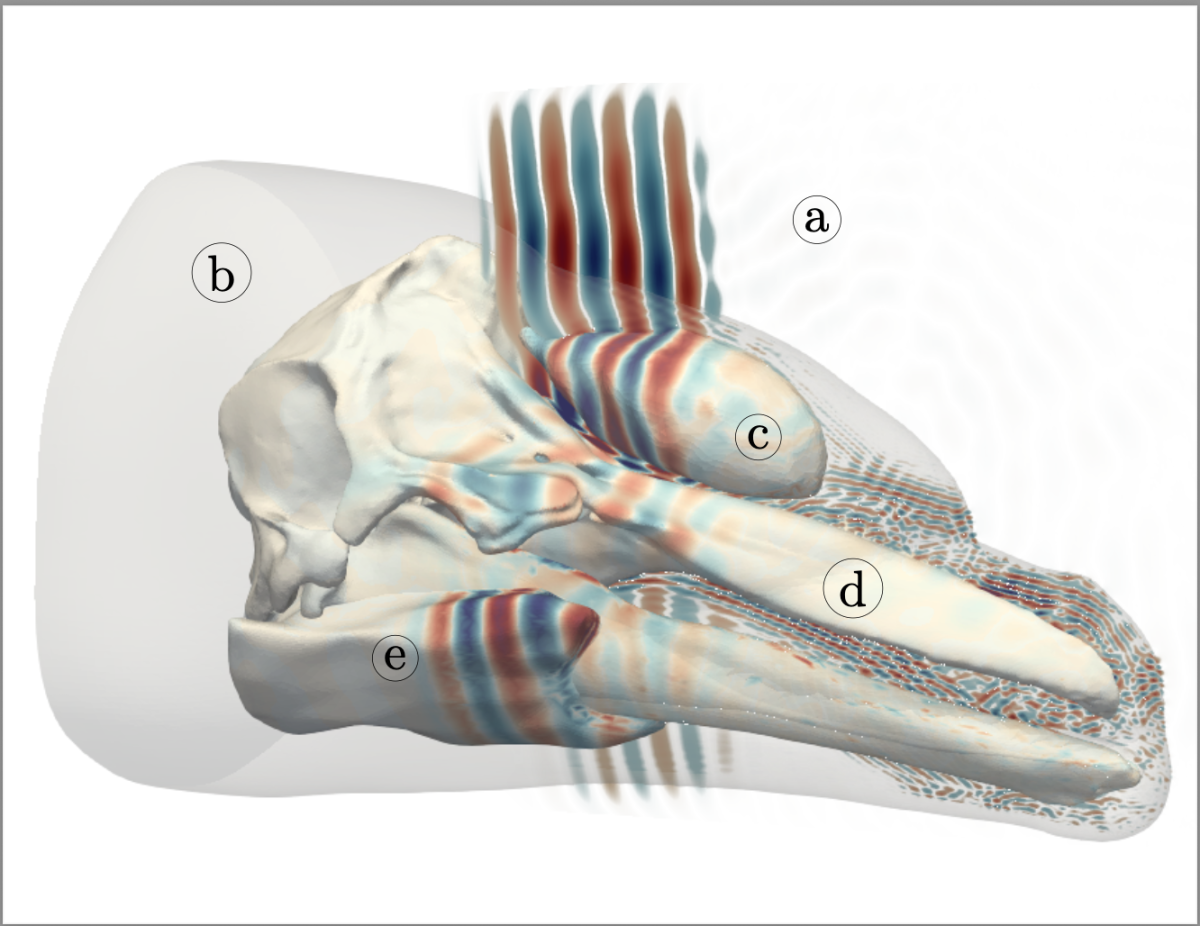
To investigate these questions, Boschi and co-authors use computed tomography scans of dolphins, which they translate into detailed anatomical maps of mechanical properties such as density, as well as compressional and shear wave velocities. They then run computer simulations of elastic wave propagation through these models. Although these simulations are complex and computationally demanding, they are still far preferable to conducting laboratory experiments on real specimens.
The results show that, because of the complexity of dolphin anatomy, the sounds reaching the inner ears vary significantly depending on the elevation of the source—even when the emitted sound is the same. So far, however, no simple direction-dependent feature has emerged: there does not appear to be a toothed-whale equivalent of the “spectral notches” observed in terrestrial mammals.
This could mean that even more advanced simulations are needed—the authors are currently working to increase the spatial and temporal resolution of their models—or that something particularly sophisticated is happening in the brains of these marine mammals.
INSIGHTS: